4 Steps To Better Retention With Follow-up Loops.
Every day people we know ask us questions like “How was the movie?” “Did you enjoy your dinner?” or simply “How’s it going?”. These questions make us feel that someone cares abo…
Every day people we know ask us questions like “How was the movie?” “Did you enjoy your dinner?” or simply “How’s it going?”. These questions make us feel that someone cares about us and our experiences, as well as help us foster stronger relationships with those who ask them.
While this is a very common practice in our daily lives, it’s surprising how few products leverage this basic human interaction to build stronger bonds with their users.
Today we are going to see how to implement organic Follow-up Loops into our products, leading to more pleasant experiences along with better retention and engagement.
1. You Need To Follow Up.
It’s amazing how few products actually have follow up loops. Usually companies focus so much on getting the user to perform an immediate action that they forget to continue the relationship, leaving the whole experience very transactional.
Speaking of transactional, let’s look at what most e-commerce communication flows are like…
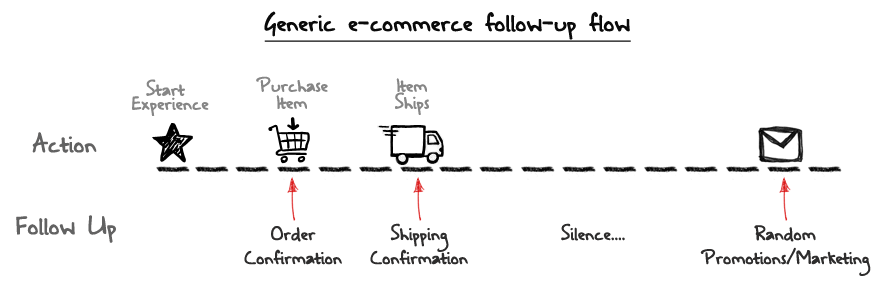
This used to work. As long as you got your customer the thing that they wanted, your job was done. Today this is not enough.
No matter if you sell goods or provide services, your customers want to be treated like VIPs, they want you to care, to listen and most of all to create awesome experiences all the way through.
This can only happen if you create and maintain deep relationships with your customers. This is how you will raise your customer satisfaction scores, get more conversions and build a better and friendlier brand.
…
2. Pick the right trigger events.
Best time to get users engaged is when they are happy, which is why you need to figure out which points of your service result in positive emotions. You can then use these points to drive the triggers for you follow ups.
Let’s take the e-commerce example above and see if there are some other touch points for us to use as conversation topics for our new friendship with our customer.

Order Confirmation — User bought something. At this point pretty much every service sends an order confirmation email, so let’s move on.
Shipping Confirmation — A day or two pass, the item is on the way and we let the customer know, their anticipation level heightens.
Delivery Follow-up — This is the day the customer has been waiting for and finally they receive what they wanted. This can be a great opportunity for a conversation.
- Confirm delivery: Through tracking services we know that the user got their order, but we can still show that we care and try to confirm that and lead in by asking “Have you received your order?”.
- Initial feedback: You can wait a day or two for this type of follow up, and by then the user should have had their initial experience with the item, so you can ask questions like “Do you like it?” “Does it fit?” “Do you have any questions?”.
Satisfaction Follow-up — Once some more time passes and the user has had more time to experience the product we can ask them to go more in depth by asking to leave a review or complete a survey. If you can gather that their experience has been positive, this could also be a good moment for recommendations based on the initial purchase.
Which leads us to the next step…
…
3. Deliver the right message, the right way.
It’s not enough to follow up. You have to make sure that the way you do it seems natural, friendly and makes sense in the overall context of the experience.
Channel — Don’t wait for the user to come back into your app or your site to pop surveys and ask questions. Email and mobile notifications are great channels to start a conversation.
Timing — You wouldn’t call your friend in the middle of the night to ask them if they had a nice weekend. Be mindful of the appropriate time to reach out and schedule your triggers so that they make sense. Through A/B testing try to pinpoint the exact time when your users are most likely to respond.
Copy — Remember that we are basing this on human behaviors, so don’t end up sounding like a robot. Understand that most of the time filling out a survey or answering questions takes energy and time. So be nice and friendly in your interactions, talk to your users, don’t market at them.
Let’s take a look at a few examples…
Example 1: OpenTable.
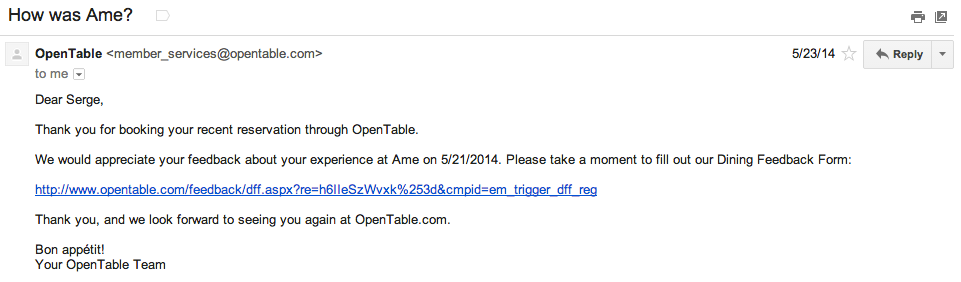
OpenTable, a service that allows you to make restaurant reservations, sends an email 2 days after your reservation date to ask about your experience. The trigger definitely makes sense and the content is pretty straight forward.
One of the things I would change here is the copy asking user to “fill out our Dining Feedback Form”. That just doesn’t sound like fun. Asking something along the lines of “Did you like your food?” or “Would you go there again?” would play much better.
Example 2: Travelzoo.
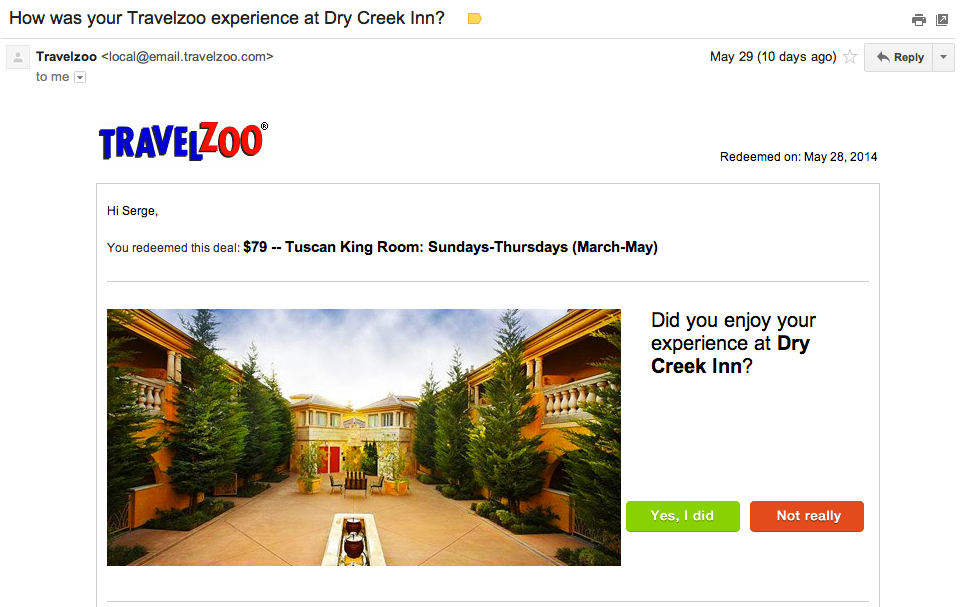
Travelzoo, a travel deals site, has pretty good execution on their follow-ups. A day after the check out an email arrives asking if the user enjoyed their stay. Much more visual than the OpenTable example, this email does a nice job reminding me about the experience with a picture of the hotel, and also emphasizes the value I received by calling out the deal details.
Both buttons lead to same destination — a survey/review page, and while that totally makes sense, I would possibly try to test a call a action along the lines of “Send me more similar deals!” tied to a recommendation campaign. The ROI of my buying another deal will probably be higher than me leaving a review.
By the way, I highly recommend Travelzoo and they did a great job with their reminder emails making sure that I used my deal before it expired.
Example 3: Ebates.
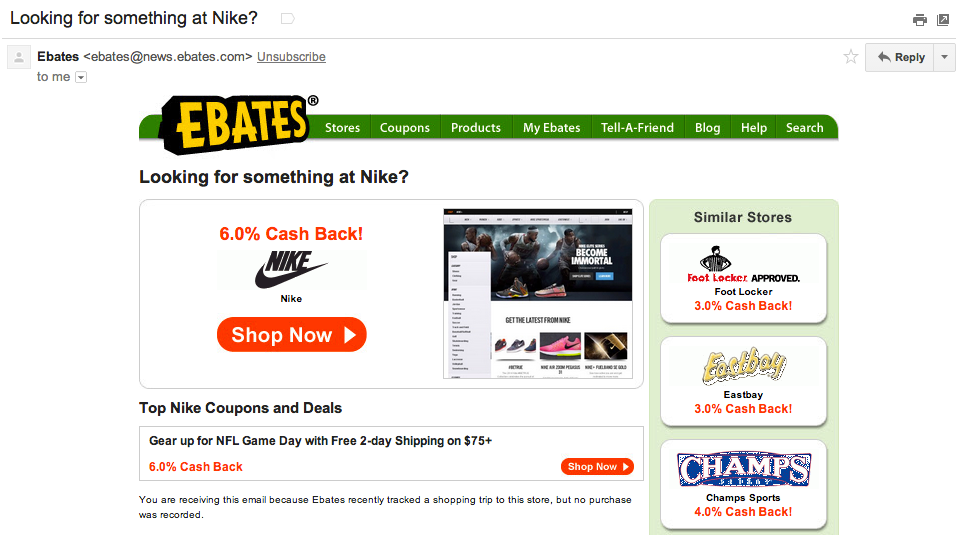
Here’s an example of a good follow-up loop based on a behavior rather than a transaction. Ebates, a site that saves you money through cash back and coupons, sends an email after I visited one of their partner sites but did not make a purchase. This was a great trigger since I was in research mode and additional savings could help me make up my mind.
This goes to show that good retention and conversion loops also consider users intentions instead of solely relying on their explicit transactional actions.
…
4. Listen to the responses.
Worst thing you can do is ask someone a question and then completely ignore their answer. The overhead of responding and giving feedback online is much higher than in our offline interactions. You’ve just succeeded in making a person go out of their way and re-engage with your service while that was likely not their primary intention at the moment.
Treasure this feedback and reward those that give it. You can do this through promos and incentives or by simply treating the cohort with more attention in your product development and continuing to build features specifically for those types of users.
…
To sum things up, these steps can be boiled down to:
a) Follow-up with the customer
b) Know what to say
c) Know when and how to say it
b) Listen and act on the response
Partner with your CRM, Design and Product Marketing teams to find a nice and consistent voice and start building better relationships with your customers.